
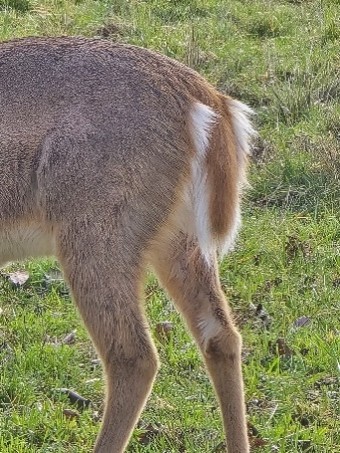
Columbian White-tailed Deer tail: they are long and they are light brown. I love that visitors get excited about the deer. Kids (including seniors who act like kids) love to compete to see who can spot and count the most deer. Lately the counts have seemed high, as many as 43 or more on a drive around the River S. With this in mind, I sought out biologist Alex to find out how many deer we have on the Refuge. But before I answer that question, a bit of history about our Columbian White-tailed Deer (CWTD).
Historically, CWTD occupied a range of approximately 23,170 square miles. They once ranged throughout the river valleys west of the Cascade Mountains from the Umpqua River in Oregon, northward through the Willamette Valley to Puget Sound, and westward down the lower Columbia River. But due to unregulated hunting and loss of habitat, by 1900, the CWTD had disappeared from nearly all of the historical range. By the 1930s, they were thought to be extinct. When remnant populations were discovered in SW Washington and near Roseburg, Oregon, efforts to save them began. The current range numbers about 93 square miles.
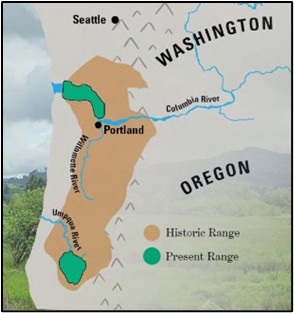
CWTD was first listed as an endangered subspecies in 1967 under the Endangered Species Act and included a population in Douglas County, Oregon and our Washington Columbia River population. In 1971, FWS established the Julia Butler Hansen National Wildlife Refuge (JBH) for the Columbian White-tailed Deer, in Cathlamet, Washington. In 1976 a recovery plan was published.
In 2003, it was determined that recovery criteria for the Douglas County OR population had been met, as it achieved benchmarks in both population size and amount of secure habitat required for a stable population. That population was delisted.

The WA population recovery planning for the CWTD included translocations of deer to a number of islands along the lower Columbia River from JBH over the early years. But the imminent threat of dike failure at JBH led FWS, in early 2013, to implement an emergency translocation of 37 CWTD from the JBH Mainland Unit to Ridgefield NWR. Seven independent-minded deer moved off the refuge quickly but most remained within roughly 2 km of their release site. These relocations aren’t without challenges and there were capture related and post release mortalities but at the end of the first effort a new population estimated at 25 CWTD was realized at RNWR. With two subsequent efforts, between 2013 and 2015, 88 deer were established to start the CWTD population at our Refuge. Some of us might remember the yellow, white and green ear tags representing each year’s release. I last recall seeing a green tag maybe a year ago. Ear tags do fall off after a lot of wear and tear.
RNWR provides good upland for a secure habitat which contributes greatly to the conservation needs of the species. We are about 67 miles southeast of JBH with our 5,218 acres of marshes, grasslands, and woodlands, about 3,800 acres being terrestrial habitat so our transplants are doing very well. So, well in fact that in 2016, as the population increased over the Columbia River areas, the CWTD were federally downlisted to threatened.
Optimal deer habitat is a mosaic of forest and grassland that provides an abundance of “edge” habitat. It consists of thick younger growth that offers cover from predators, shelter for fawns, and provides an important good food source. A deer’s diet includes: grasses, broadleaf forbs like clover, and the buds, leaves, and stems of trees and shrubs. To provide a variety of these foods, the refuge mows, grazes cattle, controls invasive species, hays, and plants appropriate vegetation. You may notice the browse lines where our deer have nibbled at small trees along the River S drive.
According to Washington Department of Fish and Wildlife, some deer and their offspring have dispersed to nearby Shillapoo and Sauvie Island wildlife areas to the south and west, respectively. Yes, they do swim across the Columbia River. A strategy of targeted acquisitions to secure more acres of quality habitat for the Columbian population has been developed by the state. One priority area for targeting is down river near Longview where small populations occupy Columbia River islands. Theses locations could provide an important linkage for dispersal and genetic exchange across the entire area. Another key area is along rivers feeding into the Columbia River which could create populations in less flood-prone areas outside the Columbia River floodplain. Given the success of Ridgefield’s repopulation effort, the state has also downlisted CWTD to threatened from endangered.
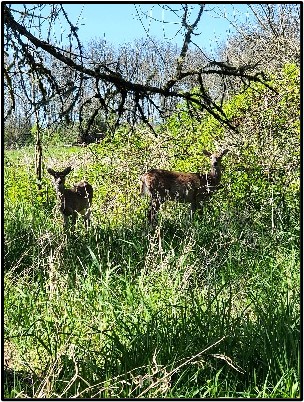
So how many CWTD do we have here at RNWR? Well, this is the fun part. Back in 1984, when the records show early counts, There were 720 individuals counted (none at Ridgefield then, of course). Not every year, for various reasons, has been surveyed since then, and the methodology has changed somewhat over time to try to increase accuracy. Five main islands in and around JBH and its mainland unit were in the count. Up until 2011, counts would vary hitting a high of 905 and a low of 545. This was mostly in response to good years of growth and then years of scarce food or increased predation.
Current technology for survey work, now done annually, is by helicopter using Forward-looking Infrared systems (FLIR). It creates images by detecting and processing infrared radiation emitted by objects, effectively “seeing” heat. Surveyors can “see” through darkness, smoke, fog, and other adverse conditions. They mostly work, though typical adverse PNW weather can be challenging. To begin FLIR counts, FWS staff and volunteers were sent into various representative habitats to see if they could be accurately counted. Some dense areas, like our Carty Unit make it more difficult to acqiure a heat signature than other areas. Information from the study helped create a “correction factor” for presumed low counts. Since the infrared reading won’t tell you if you have a black-tailed deer instead of the CWTD, ground count estimates for the small number of black-tails are determined separately and subtracted from the FLIR counts. Our Black-tailed Deer estimate for Ridgefield is slightly under 2%. Fortunately, this year weather cooperated and the team got a good count over Ridgefield on the third day of their survey. Our Official count for this year is 284 Columbian White- tailed Deer across the Refuge. It’s more than tripled in the 10 years since the relocation effort was concluded in 2015. The population for the entire SW Washington region came in at 1354 animals this year. A nice tale of success for recovery of the Columbian White-tailed Deer. We are ever thankful for all the work done by FWS staff and volunteers that work for the protection and recovery of wildlife.
-Susan Setterberg, Contact Station Volunteer


Shop for items that the Friends and the Refuge Complex need to help with everything from habitat restoration to events like BirdFest & Bluegrass, and help support wildlife in little and big ways.
Learn More »
Sign up for the Community Rewards program by linking your Fred Meyer Rewards Card to Friends of Ridgefield National Wildlife Refuge (PK822). For more information, please visit the link below.
Learn More »