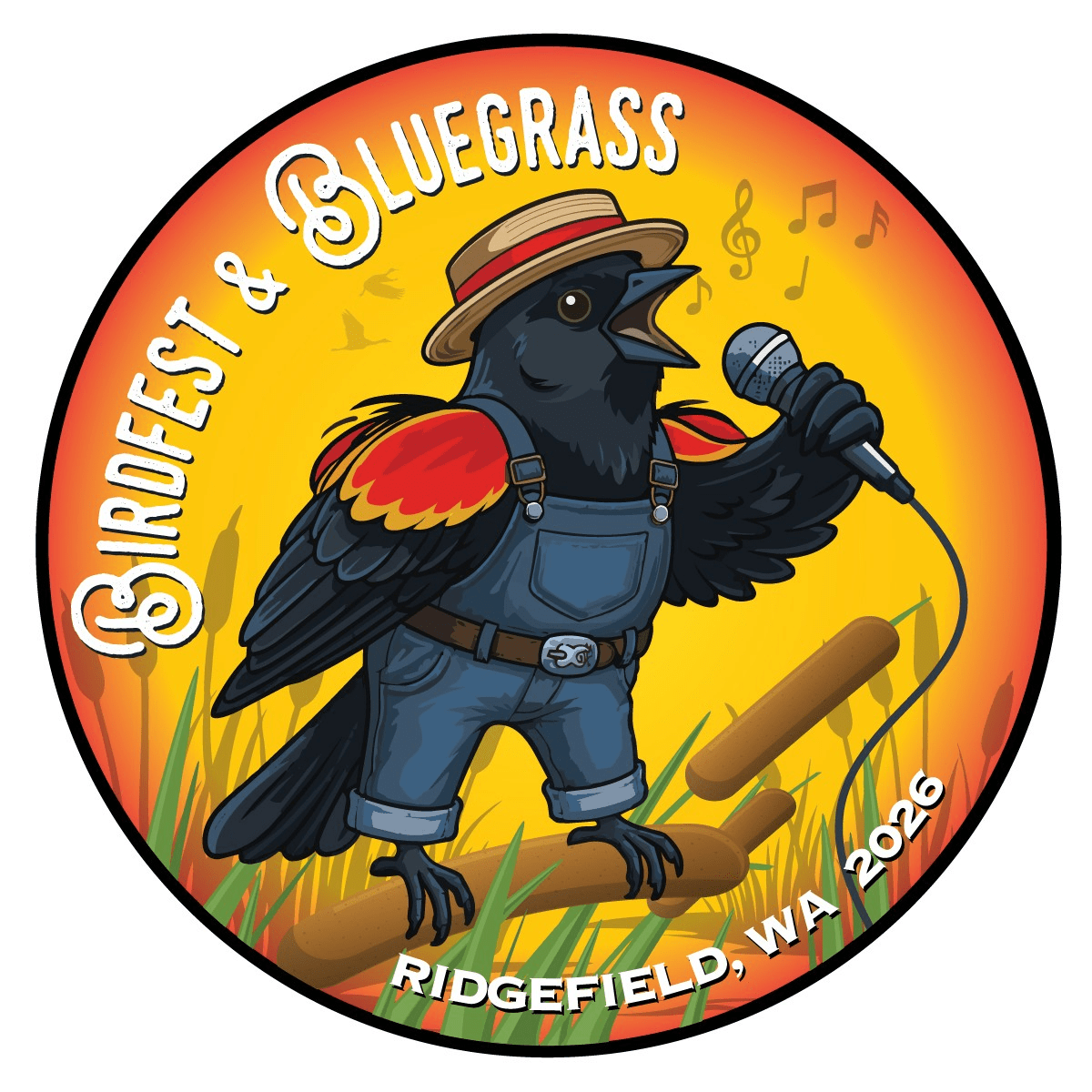
These buttons are a collector’s item, so get one before they’re gone!
Scroll down to the bottom of this webpage for details about the Bird of the Year, the Red-winged Blackbird!
BirdFest and Bluegrass is the main event every year that the Friends & the City of Ridgefield put on to bring awareness to Ridgefield National Wildlife Refuge, and all that it has to offer. We celebrate the Sandhill Crane returning to the Refuge, a huge stately bird that is endangered in Washington State, and we celebrate everything the Refuge is and what it brings to the community. With endangered species, hundreds of migratory species, an auto tour route, photo blind, walking trails, habitat restoration programs, and so much more – there is a lot to celebrate, and a lot to learn.
We are uniquely fortunate to have the Refuge as a resource right in our own backyard, and by learning not only how to appreciate the beauty, but the necessity of it, you come one step closer to being able to support it.
Whether you head downtown to jam with bluegrass bands, shop, or do crafts, take a drive around the Refuge’s Auto Tour, or head to the Carty Unit for family crafts, guided hikes, or a walk on the trail- there is something for everyone, and lots to learn!
From Dragon Boats to Bluegrass music, Kids Market, crafts, or Marketplace Vendors, find details about the schedule for downtown Ridgefield, or either unit of the Refuge. Easy to navigate and learn everything you need (and easy-to-find sign up links!)
BirdFest & Bluegrass is a joint event planned in a partnership between the City of Ridgefield, The US Fish & Wildlife Service, and the Friends of the Ridgefield National Wildlife Refuge that includes in-person self-led activities, crafts, musical performances, shopping, tours, and a Pickers Festival.
Red-winged Blackbird
Agelaius phoeniceus
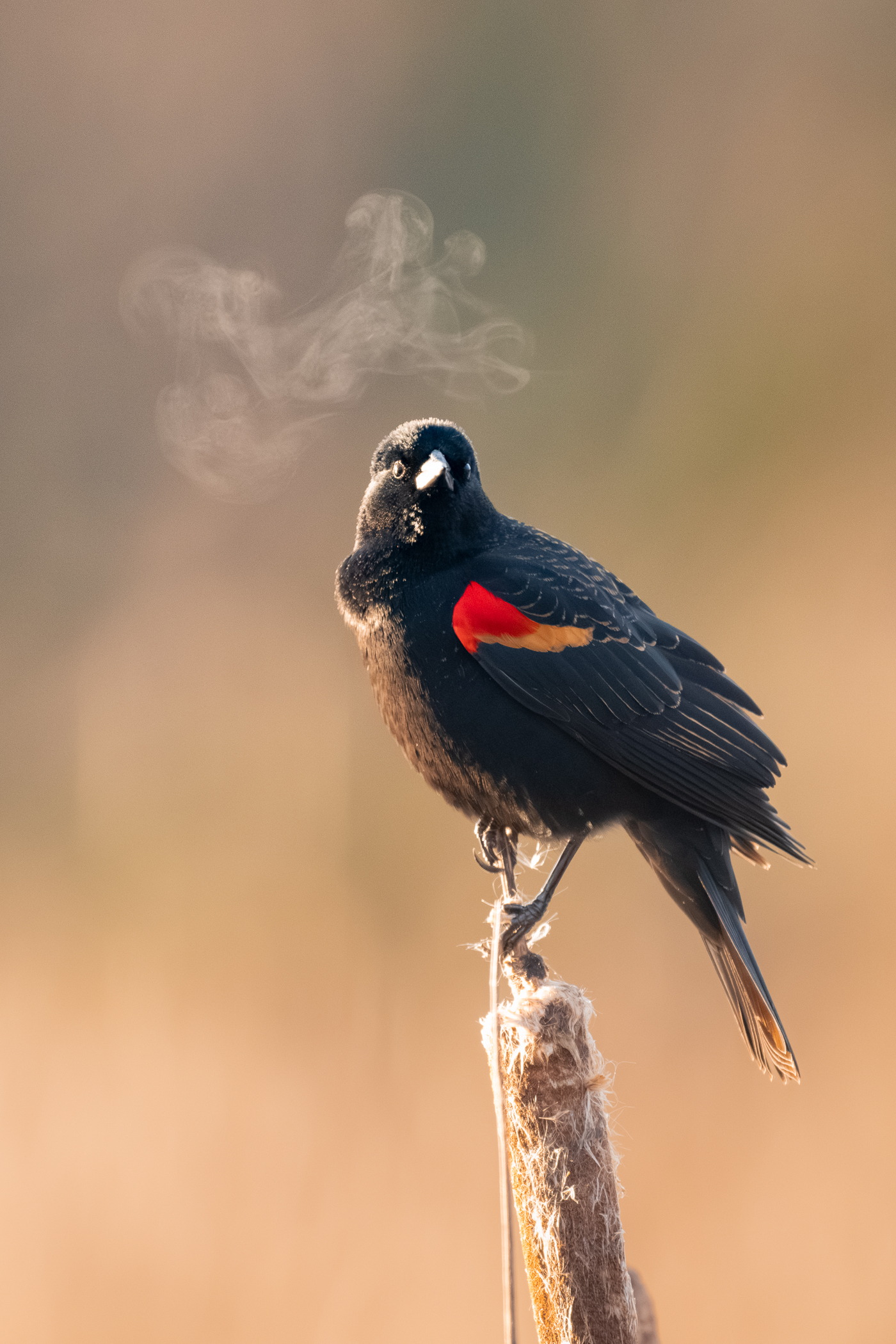
Several birds come to mind when I think of the Ridgefield National Wildlife Refuge. These include Canada Geese, Great Blue Herons, and Great Egrets. But the bird I most associate with the Refuge, at every time of year, is the Red-winged Blackbird. This is why I’m especially happy to announce that this year the Red-winged Blackbird has been chosen by Friends of Ridgefield National Wildlife Refuge members as the BirdFest & Bluegrass Bird of the Year.

This flamboyant, feisty flock-tender is an unmistakable character in wetlands. Both his loud call and his iridescent black feathers paired with the bright flash of red and yellow/orange on each shoulder are sure to catch your eye, even though he is no bigger than an American Robin. You can often spot them along the River S Unit Auto Tour, most often right as you start the tour, sitting on top of cattails on either side of the two-way stretch of road.
Flamboyant: You might notice I referred to this bird as “he.” This is because the male is the one that sports the fancy feathers, and that makes all the noise. Male Red-winged Blackbirds spend a lot of their time in spring and summer calling, mainly guarding their territory. When they make the loud “conk-la-ree!” they’re saying “this is my territory,” and they do it with more than their voices. When they call, they puff up their feathers and extend their wings slightly, flashing those bright shoulders and making themselves look larger. This warns rivals to stay away.
Feisty: It’s not just rivals that they’re keeping away. Though pretty small in the bird world, the Red-winged Blackbird will scold and chase everything from hawks and eagles to raccoons and cats, and even humans. With several loud “chak!” calls, and some precise dive-bombing, they have even gained internet fame in several viral videos while working to protect their nests from humans on walking trails. In my opinion, a Red-winged Blackbird attack rivals a goose attack. I have personally witnessed one hitting an eagle so hard that feathers poofed everywhere, and the eagle gave up and left. When nesting season is over and fall and winter hit, the blackbirds join flocks of other birds, such as cowbirds and starlings, to feed and roost, like there was never an issue.
Flock-tender: Those feisty males have to work especially hard, because they could be

protecting anywhere from five to fifteen females and their individual nests (and however many nestlings that equals!). The female and male birds work together to choose a nest site within the territory, and they work together to defend the nest itself from intruders. Both parents feed the nestlings, and between the new mouths to feed and the adults, they help control our insect populations. Once the seasons change, they’ll all eat seeds from grasses and weeds, as well as the occasional small fruit or berry.

Not being black or red, the female Red-Winged Blackbirds may not live up to their name, but their coloring is perfect for blending in with the marsh vegetation that they build their nests on. The females have striking lines of dark brown through their lighter brown feathers. They also have a whitish brow line. What is really interesting to me is, if you look closely at an immature male, you’ll notice that not only are they black with the red shoulder caps, but they also have noticeable orange lines edging their feathers or on their back. If you look at those lines side-by-side with the plumage of the female, the lines line up almost exactly. It just shows that even though males and females look wildly different from one another at a glance, they aren’t that different after all.
This year, Ridgefield National Wildlife Refuge opened the doors to a new Community Nature Center building, and one of the features of the new parking lot layout is a small circle of plants and grasses and seasonal water in the center of the bus drop-off driveway. As we hurried to stock the classroom with tables and stools before the first class stepped foot in the new building, we all heard the familiar call of a Red-winged Blackbird that had staked his claim to this drop-off circle watering hole. We weren’t the only ones to notice either. As soon as students arrived, they also heard and pointed out the familiar – or asked about the not-so-familiar – sound. Soon, Refuge staff and volunteers began thinking of them as an ambassador bird for all education programming. This made it an easy pick for our members during our Annual Membership & Volunteer Appreciation event in May, and is why we are so excited to highlight this special bird for BirdFest & Bluegrass 2026!
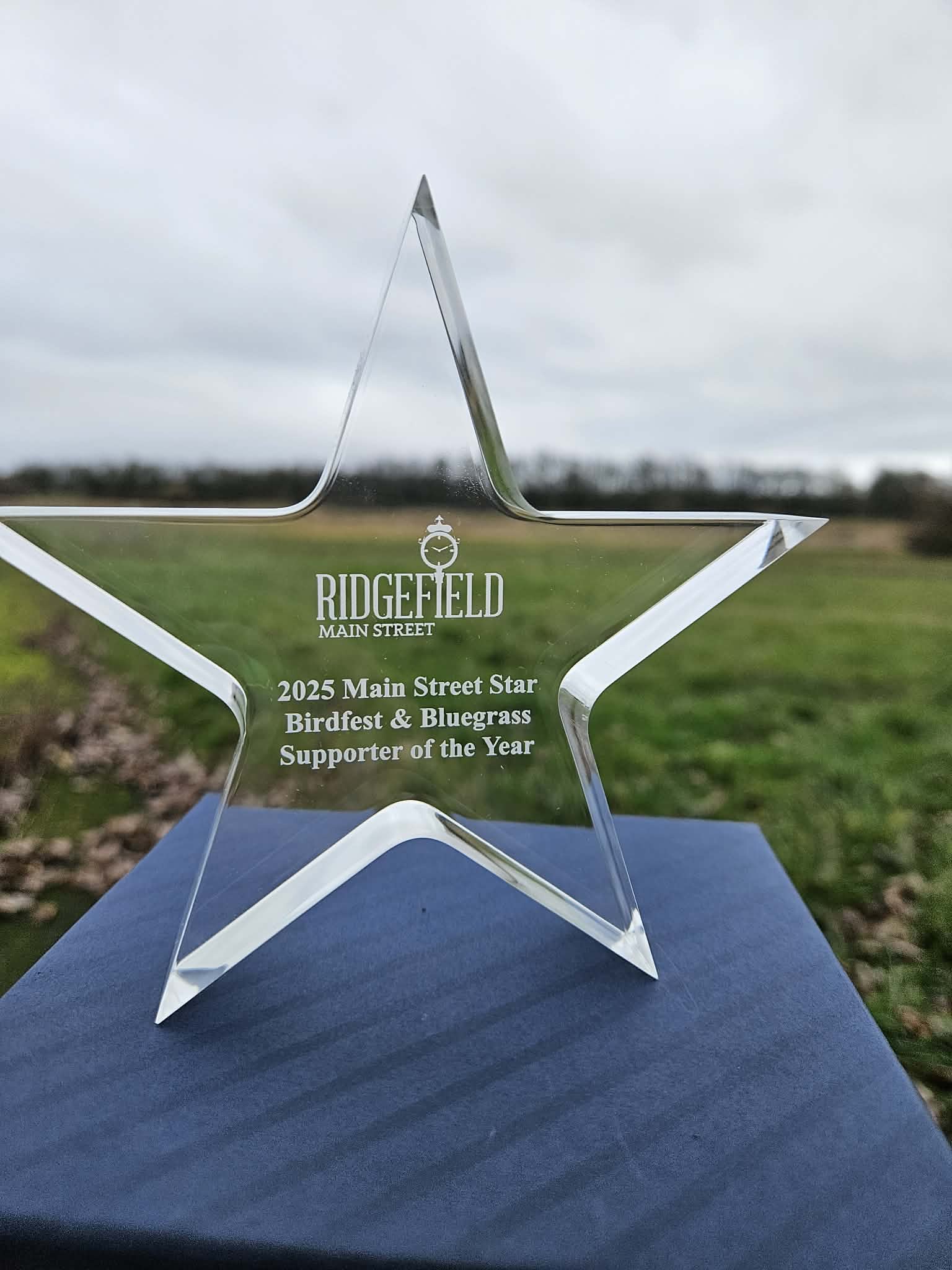
We are absolutely thrilled and deeply honored to announce that BirdFest & Bluegrass has been awarded the 2025 Main Street Star Award – Supporter of the Year by Ridgefield Main Street!
To be nominated for this award was an honor in itself, but to win is truly humbling. The Friends of Ridgefield National Wildlife Refuge received this incredible recognition in December, and we have just been overflowing with gratitude ever since.
This award belongs to our whole community! A massive thank you to the volunteers, our supporting local businesses, and every visitor who makes BirdFest & Bluegrass the amazing celebration it is every October. Your dedication is what makes this event a success and keeps the heart of Ridgefield beating strong.
Thank you for helping us support this wonderful community!











Stay updated on Refuge events, news, and wildlife sightings!

Shop for items that the Friends and the Refuge Complex need to help with everything from habitat restoration to events like BirdFest & Bluegrass, and help support wildlife in little and big ways.
Learn More »
Sign up for the Community Rewards program by linking your Fred Meyer Rewards Card to Friends of Ridgefield National Wildlife Refuge (PK822). For more information, please visit the link below.
Learn More »