 I was very young, maybe ten years old, and we were returning to the Bay Area from a visit with my grandmother in Mt Shasta, CA. It was old Highway 99 back then, a two-lane road that moved through vast landscapes I didn’t have the knowledge to understand or appreciate. Along that road somewhere north of Corning was a wayside stop called The Snake Pit. No, not a biker bar. My dad and I went in to find a big collection of slitherers. The owner, an old skinny grizzled man, walked us by the elevated display cases of old plywood bottoms and glass fronts to see his snake collection. He regaled us with stories of the Black Mamba deadly enough to kill a room full of people. Oh my. As we walked by the rattlers, coral snakes, the Gila Monster and other species I don’t remember, he banged on the bottom of the cases and the Cobra became alert, rising and spreading its hood. Being a little 10-year-old, that snake and I were eye to eye. Wow, I couldn’t wait to get back to the car and tell my mother all about the adventure, which she had declined to join in.
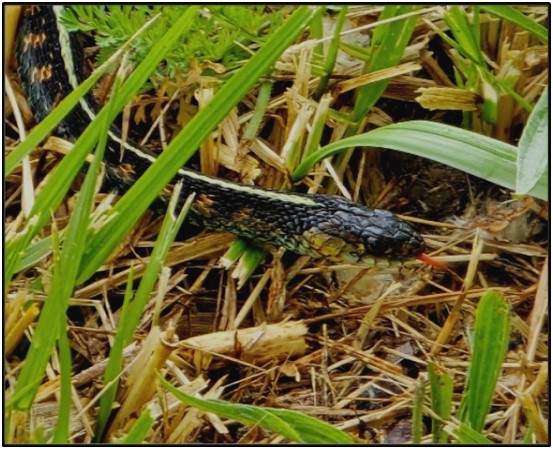 I find that same excitement looking for and finding our beautiful Common Garter Snakes that are easy to find at this time of the year. Quietly walk around mowed edges of the Contact Station, the path to the blind or the road. Stand still and watch the grass for movement. If you spot one with a little luck it will move by you tasting the air as it goes. Note the red tongue sticking out in the photo. They are skittish and will sneak off into a hole or thick brush before you can raise your camera if they detect your presence, so stealth walking is important for your success.
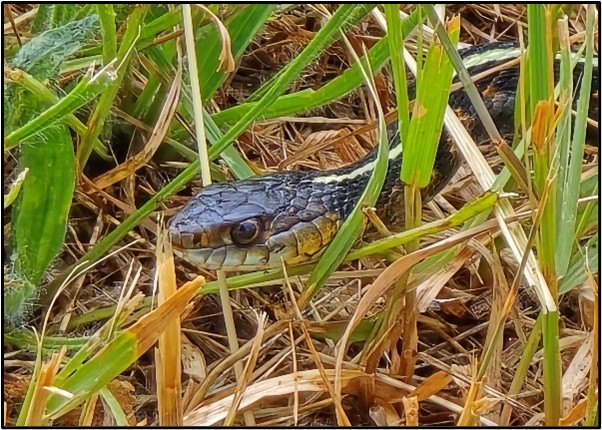
The Common Garter Snake, Tamnophis sirtalish concinnus, is indeed common in Southwest Washington and its status is considered secure. In western Washington, our garter snakes come in a variety of colored lateral stripe on their slate gray or black ground color. Stripes can be yellow, green, turquoise or blue. The stripes may be all the same color or vary. Their underside is usually yellow or cream under the chin with increasing black as you move toward the tail end. But if you find one with blue lateral stripes, it will likely have a blue ventral color too. You might see red blotches along the sides. The blotches can vary in color intensity or shape, sometimes appearing orange too. These blotches give it the alternate name of Red-spotted Garter Snake.
The garter snakes are almost always found near water. But they overwinter in dryer terrestrial sites moving seasonally. At low elevations like ours, snakes may be surface active in the vicinity of the overwintering site whenever site conditions warm over about 55° F. We usually initially see them along the walk to the toilets when the cement is warmed by the sun, sometimes as early as late March.
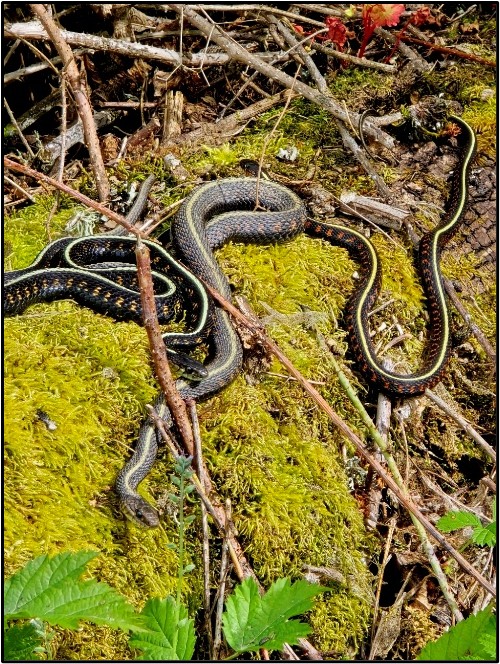 Garter snakes breed in spring after emergence. Males come out first, spending time on the surface near the overwintering sites. When a female emerges, the males will attempt to mate with her forming a “mating ball” of many males around a single female. After mating, they disappear into summer foraging areas. Females are commonly found clustered in open grassy areas. It is thought this might have to do with ease of thermoregulation and gestation. Young will be born in late summer and early fall, depending on location.
But even more interesting though, males and females release pheromones to attract mates and determine who is who in the mating ball. In some populations, there are males that can produce both pheromones. They will exude the female pheromone and lure other males away from the female’s burrow. The double secreter can then change to male pheromone and get back to the den first when the females later emerge. He is then first to mate with all the females he can catch. Sneaky little dude.
As the snakes disperse from mating, they are often crossing our auto tour roads. This is the time to carefully watch for that moving stick on the road. Sadly, the spring never passes without the loss of a few snakes to drivers not paying attention.
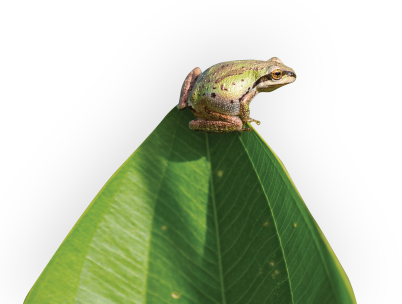
Garter snakes are carnivorous. They will eat what they can overpower. They eat slugs (not much of a fight there I would think), earthworms, lizards, minnows, rodents and amphibians. Garter snakes are good swimmers and can hunt on and below the water surface. I once saw what I thought was a snake head in the slough between #2 and #3. It was brief, and looking around, I saw a number of turtles so I shrugged it off as a turtle head. But now, knowing garters are good swimmers, I think that is what it was. Juvenile garter snakes are known to hunt newly metamorphosing Pacific Treefrogs in shallow water. We have a lot of those here too, I’ve read they will take Bull Frogs too, a good selection from our invasive species list. Like most snakes, garters can open their mouths very wide. I am guessing they probably go for the younger bull frogs. Stretching their mouth around one of our adult bull frogs? Well, I would like to see that photo.
Interestingly, common garter snakes are one of the few vertebrates that can successfully prey on the extremely toxic Rough-skinned Newt, which we have on our refuge. Research indicates these snakes harbor active toxin in their tissues (particularly liver) after consuming a newt. The snake isn’t entirely free of toxin effect as some of them are slowed down after eating, which can make them a sitting duck for a hungry raptor flying overhead. On the other hand, the amount of toxin consumed by the snake varies depending on the number of newts eaten, but it is believed the amount can be enough to incapacitate or kill avian predators and negatively affect mammalian predators. For our photo contest often we have been treated to Great Blue Heron pictures with a snake in their bill. Luckily, we haven’t seen any dead Great Blue Herons over the years. There is a lot of scientific study on co-evolution between the newts and the garter snakes, if you want to dig a little deeper, OPB has a nice piece on the garter snake and the newt which can be found at: https://www.pbslearningmedia.org/resource/tdc02.sci.life.evo.toxicnewts/toxic-newts/
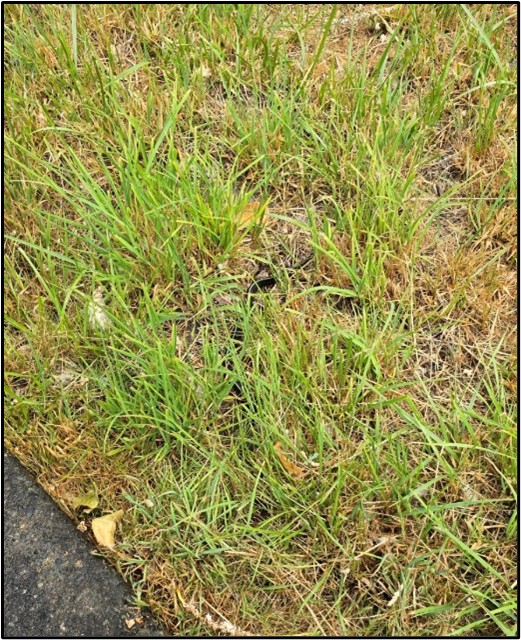
Also, garter snakes have a mild venom in their saliva, which can be toxic to their prey, helping them to secure a meal. Although they will protect themselves by biting, as when they are picked up and restrained, they do not often break our skin and only cause mild itching, burning and swelling when they do. However, on the refuge, we don’t pick up snakes. We respect all animals’ space and leave them alone, so no problems there.
There is much to be learned about the life and times of the Common Garter Snake; much more than I have space to cover here. Remember, if you want to do some stealth searching, our garter snake is diurnal. In summer, it is most active in the morning and late afternoon; in cooler seasons it restricts its activity to the warm afternoons. Carry your camera at the ready and walk softly.
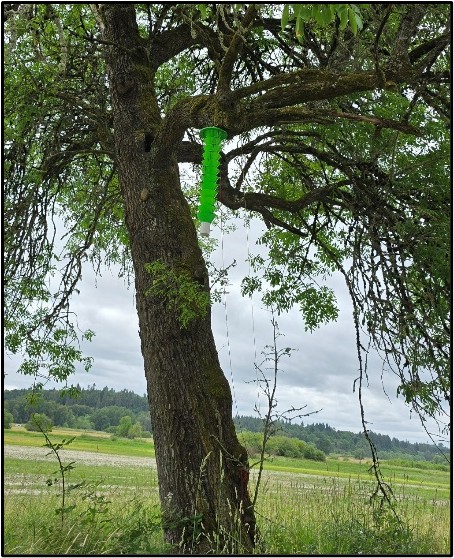 In other news: Have you noticed the green lanterns are back? For those of you who might not have seen them in past years, they are baited stations to specifically attract Emerald Ash Borers. Why? The borers have done a lot of damage to ash forests as they have moved across the country from the Midwest where they were discovered in 2002, killing over 100 million ash trees along the way. The Emerald Ash Borer is a jewel beetle native to north-eastern Asia that feeds on ash species. The female lays eggs in bark crevices. The larvae spend a year or two tunneling through the inner bark of the tree, destroying its ability to transport nutrients and water up into the tree tops. Ash trees generally die within five years of becoming infested. Unfortunately, an infestation was found in Forest Grove, Oregon three years ago and in Woodburn, OR last year. Since then, several other infestations have been found in Oregon.
FWS is diligently monitoring the ash groves here. They play an important role in our refuge. Our ash trees provide food, shelter, and nest habitat for a wide variety of wildlife. Once the canopy dies, other invasive plants will take off. It is not like we need more blackberry. Loss of shade over our sloughs affects fish and other water creatures. There are no good replacement native species for Ash trees that thrive in our very wet areas. Plans have been developed to mitigate the problem if they are found in our refuge but it often means loss of a lot of trees to stop their spread. One solution is infested tree removal to burn or chip into1-inch pieces to kill the larvae. Some areas in Oregon are using a parasitic wasp species which locates the larvae in the tree and feeds on it so it dies. In other areas, they are removing trees to do a more diverse forest planting ahead of infestation where that will work. We can keep our fingers crossed, but more realistically, we need to continue to prepare.
Just for Giggles: Have you ever had the opportunity to watch a Wilson’s Snipe call out? Watch the tail move with each call. He obviously puts a lot of effort into his song to find a mate.
-Susan Setterberg, Contact Station Volunteer
Photos and Text by Susan Setterberg
Stay updated on Refuge events, news, and wildlife sightings!


Shop for items that the Friends and the Refuge Complex need to help with everything from habitat restoration to events like BirdFest & Bluegrass, and help support wildlife in little and big ways.
Learn More »
Sign up for the Community Rewards program by linking your Fred Meyer Rewards Card to Friends of Ridgefield National Wildlife Refuge (PK822). For more information, please visit the link below.
Learn More »