If you’ve ever noticed perfectly cut semicircles missing from your rose, lilac, or hosta leaves during summer, you may have had a visit from a leafcutter bee. They need 70-degree weather to emerge and are active from late June through August, silently working behind the scenes in your garden.
Leafcutter bees belong to the Megachilidae family (pronounced meh-guh-KIL-ih-dee), which they share with their early-spring cousins, the Mason bees. The name Megachilidae refers to their “large lips” — a nod to the powerful mandibles or jaws they use to snip neat, rounded pieces from soft-leaved plants. Unlike insect pests that indiscriminately chew leaves, leafcutters are artists of precision. Each cut is intentional and functional.
These bees aren’t eating the leaves — they’re building nurseries. The female leafcutter bee carefully lines and partitions her nest using the leaf pieces, giving each egg its own “bedroom.” She constructs these leafy chambers in existing cavities like hollow stems or in the ground. Instead of feeding larvae like non-native honey bees do, solitary leafcutter bee mothers, like most native bees, gather a ball of pollen and nectar and leave it in a sealed chamber with each egg. It’s essentially a pre-packed meal for the larva to eat after hatching.
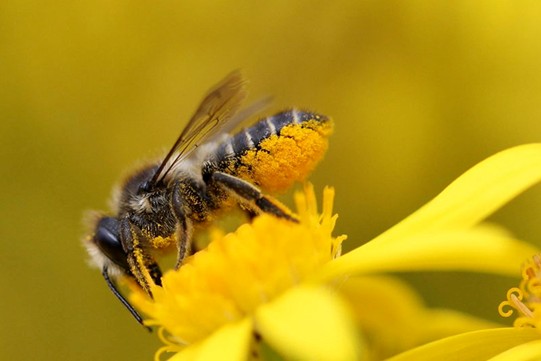
And here’s another surprising fact: leafcutter bees carry pollen on their tummies! Unlike honey bees that use specialized leg baskets, leafcutters have stiff hairs on the underside of their abdomens where pollen sticks — giving their bellies a noticeable yellow dusting as they travel from flower to flower.
Despite their stealthy habits, leafcutters are powerhouse pollinators, visiting a wide variety of plants and pollinating up to 95% of the flowers they visit. Their partnership with flowering plants is the result of millions of years of co-evolution. Flowers offer food and nesting materials, and in return, the bees pollinate the flowers, enabling them to produce seeds and fruit — ensuring the cycle of life continues.
So, the next time you spot a few tiny, precise holes in your garden leaves, think of them as the gentle handiwork of a hardworking bee mother, crafting a nursery for the next generation of pollinators. There’s no need to worry — the plants aren’t harmed, and your garden is benefiting from their visit in more ways than one.
💡 Tip: Choose integrated pest and pollinator management (IPPM) techniques and spray only as a last resort, in the evening when bees aren’t active.
-Anne Bulger, Friends of Ridgefield NWR Board Member, & OSU Master Melittology Lead Instructor for the RNWR
Stay updated on Refuge events, news, and wildlife sightings!


Shop for items that the Friends and the Refuge Complex need to help with everything from habitat restoration to events like BirdFest & Bluegrass, and help support wildlife in little and big ways.
Learn More »
Sign up for the Community Rewards program by linking your Fred Meyer Rewards Card to Friends of Ridgefield National Wildlife Refuge (PK822). For more information, please visit the link below.
Learn More »