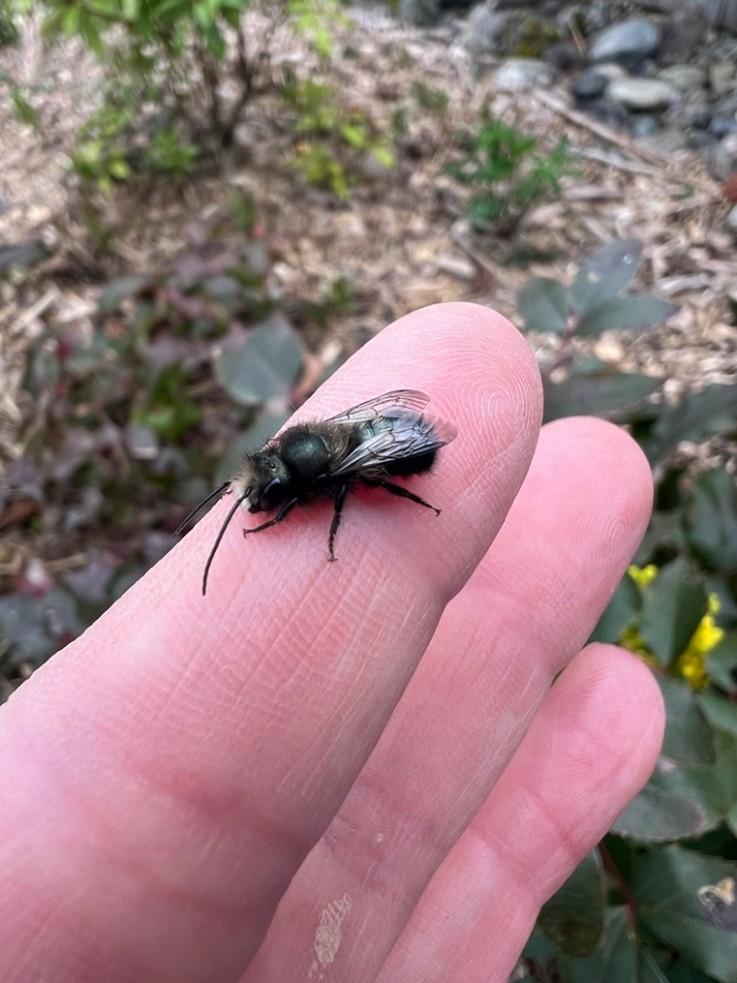
If early spring had a mascot, it might be a small, metallic bluish-black bee with a pollen-dusted belly. Meet Osmia lignaria — our truly native Blue Orchard Mason Bee (BOB) here in Clark County —is one of the quiet champions of spring bloom.
While honeybees are still warming up for the season, Mason bees emerge when temperatures reach about 50–55˚ and are already on the job. Our BOBs fly in cool, even rainy weather, visit thousands of blossoms, and pollinate with remarkable efficiency — about a 95% pollination rate compared to roughly 5% for honeybees. No hive. No swarm. No drama. Just one hardworking Mason bee female and her mission.
Her to-do list is simple: build a nest and stock the next generation.
Mason bees are solitary, which means every female is her own queen and construction crew. Instead of building a wax comb, she looks for a narrow tunnel — a hollow stem or nesting tube — and gets to work. Her building material? Mud. She gathers pollen and nectar, lays a single egg on a carefully prepared pollen loaf, then seals the nursery room with a tidy wall of mud. One chamber, one baby, one mud door. Repeat.
She’ll do this about 20-35 times in her short four-to-six-week adult life. That’s a lot of flights and a lot of flowers visited — excellent news for our fruit trees and early-blooming flowers.
Mason bees are also gentle neighbors. Because there is no hive to defend, they rarely sting — only if pressed or squished. You can safely watch them come and go like tiny delivery drivers, frequently mistaken for flies, but wearing a much shinier uniform.
Want to help them succeed? Think spring-blooming flowers, a bit of mud, and fewer chemicals in the landscape. Even a small patch of bloom makes a difference — and remember, they usually travel only about the length of a football field from home. Want them to stop by your backyard? Make sure the menu is open in March and April, with both native and non-native blooms ready to supply nectar and pollen to our tireless female Mason bees committed to quality work.
Small bee. Short season. Big impact.
That’s this month’s Bee Story — told by a bee that looks like a fly and sealed with mud.
The Oregon State University Garden Ecology Lab’s research recommends these native plants as attractive to many different bee species:
1. Varileaf phacelia
2. Globe gilia
3. Douglas’ aster
4. California poppy
5. Farewell to spring
6. Rose checkermallow
7. Common madia
8. Canada goldenrod
9. Oregon sunshine
10. Yarrow
11. Big leaf maples
12. Oregon grape
13. Willows
14. Fruit trees
15. Red flowering currant
– Anne Bulger, Friends of Ridgefield NWR Board Member, & OSU Master Melittology Lead Instructor for the RNWR
Image: Blue Orchard Mason Bee by mererivin/iNaturalist
In the last two years, 87 species of bees have been collected at Ridgefield National Wildlife Refuge.
Check out the species list below, which also accounts for a small number of bees still only identified at the genus level.
Thanks to Board Member Anne Bulger,
and August Jackson, Refuge Program Coordinator & Taxonomist
Oregon Bee Atlas
Melittology Lab | Department of Horticulture | Oregon State University
www.Melittoflora.org
Stay updated on Refuge events, news, and wildlife sightings!


Shop for items that the Friends and the Refuge Complex need to help with everything from habitat restoration to events like BirdFest & Bluegrass, and help support wildlife in little and big ways.
Learn More »
Sign up for the Community Rewards program by linking your Fred Meyer Rewards Card to Friends of Ridgefield National Wildlife Refuge (PK822). For more information, please visit the link below.
Learn More »