This month, rather than highlighting a single native bee, I found myself drawn to the broader experience of surveying them in the field. As an OSU Master Melittologist and a Washington Bee Atlas volunteer, I have the privilege of stepping into landscapes not just as an observer, but as a quiet participant in a much larger, living system.
For the second year, Abby Braithwaite and her husband, David Morgan, have generously welcomed us onto Plas Newydd Farm. Their land rises above Lancaster Lake and Gee Creek, a mosaic of open fields and shaded forest that feels both expansive and intimate at once. It is the kind of place that invites you to look both outward across the landscape and downward into the details.
In the open fields, camas stood among a vibrant community of spring bloomers, including spring gold, seablush, and western buttercup. Together, they created a patchwork of color and pollen resources that drew in a steady stream of pollinators. Bumblebees and Mason bees moved deliberately through the camas, gathering what they needed in a rhythm as old as the landscape itself.
Just beyond the fields, the forest shifted the experience entirely. In the cool shade, fawn lilies bowed gently above the forest floor, and patches of miner’s lettuce quietly hosted a surprising number of pollinators. The contrast between sunlit fields and shaded understory revealed how different plant communities support different layers of life, each essential in its own way.
Dragonflies traced the air above the fields, some with wingspans wide enough to command my attention, while closer to the ground, the quieter work of pollination continued.
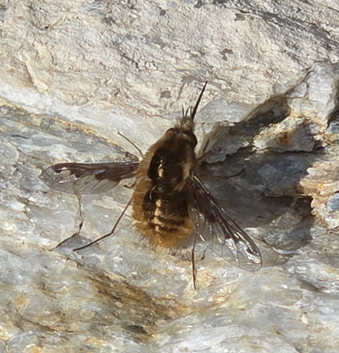
At one point, as I moved through the field collecting specimens, I turned to find a striking formation of bee flies (see photo) hovering just behind me, almost like a Blue Angels formation of sentries suspended in the air. These bee flies (Bombylius spp.), often called bomber flies, mimic bees, in this case bumblebees, complete with a loud, unmistakable buzz. They are efficient pollinators in their own right, moving from flower to flower with precision. Yet their story carries another layer. In their adult stage, they flick their eggs into the nesting tunnels of native bees, where their larvae take advantage of the provisions left behind, developing within the nest. It is a reminder that even within these systems of abundance and cooperation, there are more complex and less visible interactions at play.
Once the sun broke through the clouds, the landscape came fully alive. Pollinator activity increased, and the air seemed to hum with movement and purpose.
There were moments when I set aside my net and sat down, allowing the work to pause. In those quiet intervals, I was reminded not only of the richness of the landscape, but of the generosity that makes this work possible. I feel fortunate to participate in this effort, and deeply grateful to neighbors like Abby and David, whose stewardship of their land creates space for both people and pollinators to thrive.
-Anne Bulger, Friends of Ridgefield NWR Board Member, & OSU Master Melittology Lead Instructor for the RNWR
Stay updated on Refuge events, news, and wildlife sightings!


Shop for items that the Friends and the Refuge Complex need to help with everything from habitat restoration to events like BirdFest & Bluegrass, and help support wildlife in little and big ways.
Learn More »
Sign up for the Community Rewards program by linking your Fred Meyer Rewards Card to Friends of Ridgefield National Wildlife Refuge (PK822). For more information, please visit the link below.
Learn More »