November may seem like an odd time to think about bees. The buzz of summer is quieting, flowers are fading, and many of the native bees we watched throughout spring and summer have completed their lives.
But November is a wonderful time to think about the bees we’ll meet next year—and to plant for them.
I have the luxury of gardening on acreage, which means I can usually find room for a native plant even if it wants to spread, grow large, or wander a bit. A plant that is perfectly at home on my property may be far less welcome in a residential backyard.
For this article, I gave myself an additional challenge: What would I recommend to someone who wants a garden rich in native bees, but also wants plants that can be reasonably managed in a typical backyard?
Fall planting gives many perennials, bulbs, and shrubs an opportunity to begin establishing roots during our cool, wet Pacific Northwest months. And rather than thinking about a pollinator garden as something that blooms spectacularly for a few weeks in summer, I like to think of it as a calendar.
The goal is simple: something blooming for bees from early spring through fall.
Begin with the earliest bees.
Some of the most important plants in a bee garden may be the ones flowering before we’re really thinking about gardening.
Oregon grape (Berberis nervosa) is one of my favorites. Its yellow flowers provide early pollen and nectar when relatively few other plants are blooming. There are different species and forms, so choose one whose mature size fits your space.
Red-flowering currant (Ribes sanguineum) is another beautiful early bloomer. Its dangling pink flowers attract plenty of pollinator attention. It can become a substantial shrub, however, so give it enough room from the beginning. If you need to reduce its size, prune it after flowering. Thoughtful placement is much easier than continually trying to force a naturally large shrub into a small space.
And fall is the perfect time to plant Camas (Camassia quamash) bulbs. Tuck them into the ground now and wait. Their blue flowers will emerge in spring and provide another valuable food source for visiting bees.
Keep the succession going…
As the earliest flowers fade, we want something else waiting.
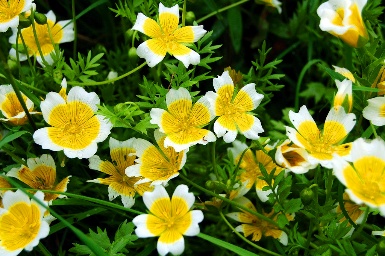
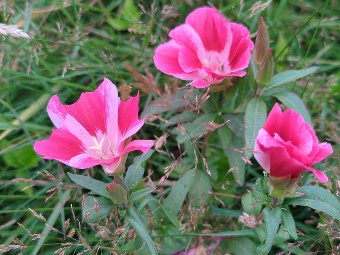
Douglas meadowfoam (Limnanthes douglasii) provides spring bloom, while Clarkia (Clarkia amoena) can help carry the garden toward summer. Clarkia may reseed, but in a residential garden unwanted seedlings are relatively easy to pull.
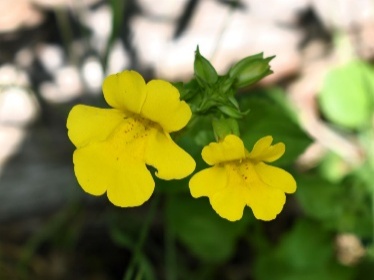
Yellow monkeyflower (Erythranthe guttata) is another native I like for a backyard bee garden. Its bright yellow flowers add color while providing another source of pollen and nectar for visiting bees. It works especially well in a sunny location with adequate moisture and can help extend the succession of bloom from spring into summer.
Nodding onion (Allium cernuum) is particularly nice for a backyard bee garden. It is native, compact, doesn’t demand a large piece of garden real estate, and its clusters of small flowers attract bees.
For gardeners with a little more room, Mock Orange (Philadelphus lewisii) provides wonderfully fragrant flowers on a native shrub. Again, check its mature dimensions first and give it the space it needs rather than planning to keep a naturally large shrub artificially small.
Summer gives us plenty of choices.
By summer, finding flowers for bees becomes easier.
Common Madia (Madia elegans) is one I enjoy watching for bee activity. It may reseed, but unwanted seedlings can be thinned to keep it where you want it.
This is also where I make room for some nonnative plants.
A garden for native bees doesn’t necessarily have to be an exclusively native plant garden.
Oregano (Origanum ‘Kent Beauty’) is a perfect example. Let it flower and then spend a few minutes watching it. Those tiny blossoms can become remarkably busy with bees. If it begins traveling beyond its allotted space, remove unwanted growth or cut the flower heads before seed disperses.
Russian sage (Salvia yangii) is another nonnative that earns a place in my bee garden. Its long-lasting purple-blue flowers can be remarkably busy with bees from summer into early fall. For a residential garden, choose a more compact variety if space is limited and remove unwanted shoots if it begins to wander. Its long flowering period makes it particularly useful for helping bridge gaps between summer and fall bloom.
And don’t overlook something that may already be growing in your lawn.
Save a patch of dandelions!
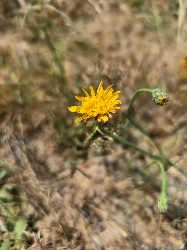
I know this suggestion won’t appeal to everyone, but I leave some (many) dandelions.
Dandelions can flower over an unusually long period. We may see them beginning in early spring and continuing sporadically through much of the growing season.
That becomes especially interesting during a nectar dearth—a period when relatively few plants are producing abundant nectar.
When the garden is overflowing with flowers, bees have choices. During a gap in bloom, a flower we dismiss as a lawn weed may suddenly become one of the available places for a hungry bee to refuel.
Dandelions provide both pollen and nectar and are visited by a variety of bees. They shouldn’t be the only food available; bees benefit from a diversity of flowers and pollen sources. But dandelions can help bridge some of those gaps.
You don’t have to surrender your lawn to them. Leave a patch in an out-of-the-way area and remove plants that appear where you don’t want them before they go to seed.
I think of dandelions as part of the backup pantry in my bee garden. When everything else is blooming, the bees have plenty of choices. When flowers become scarce, that ordinary yellow flower may matter much more.
Don’t forget late summer and fall.
This end of the bee calendar is easy to overlook.
Goldenrod (Solidago canadensis) can be tremendous late-season bee forage, but it is one plant I would choose carefully for a residential garden. Some types spread enthusiastically. Choose one suited to your available space, give it a defined area, and remove unwanted spreading growth while it is still easy to manage.
Native Oregon Stonecrop (Sedum oreganum) is another I happily make room for. It is generally easy to manage, drought tolerant once established, and its late flowers can be remarkably busy with pollinators.
Common Evening Primrose (Oenothera villosa) can also earn a place, particularly if you’re comfortable with a somewhat informal garden. Some types reseed enthusiastically, so deadhead before seeds mature if you don’t want volunteers.
All of these can help keep pollen and nectar available as summer winds down.
Why aren’t all of my favorite bee plants on this list?
Because this is a backyard bee garden.
I see tremendous bee activity on Scorpionweed or Phacelia, but I also know how readily it can spread. On acreage, I can give it room. In a small residential garden, someone may eventually spend more time containing it than enjoying it.
Lupines are beautiful native plants, and in my experience, they are especially popular with bumble bees. They certainly have a place in a pollinator landscape, but for this garden, I wanted to emphasize a selection of plants that together attract a broader assortment of native bees while remaining practical for a residential setting.
And while Balsamroot can be a wonderful bee plant where conditions suit it, it isn’t one of my first choices for the average west-side backyard.
A terrific bee plant isn’t necessarily the right plant for every garden.
Flowers are only part of a bee garden
While you’re planting this fall, remember that native bees need more than something to eat.
Most of our native bee species nest in the ground. Others use existing cavities or hollow and pithy stems, while bumble bees may establish colonies underground or in other protected cavities.
Leave some patches of bare, undisturbed soil. Keep some stems standing. Allow leaves and woody material to remain in portions of the garden. And avoid pesticides whenever possible.
That slightly untidy corner may be doing more for bees than we realize.
Build your garden one season at a time. You don’t need to plant everything at once.
Instead, look at your garden as a calendar and ask:
Find the gaps and fill them one at a time.
A pollinator garden doesn’t need to be large, exclusively native, or unruly. It needs diversity, habitat, and flowers appearing in succession throughout the months when bees are active.
This Fall, don’t worry about creating the perfect bee garden.
Plant something for one season that’s missing, leave a little habitat behind, and begin building your bee garden from there.
By Anne Bulger, Friends of RNWR Board Member, & OSU Master Melittology Lead Instructor for the RNWR Complex
Stay updated on Refuge events, news, and wildlife sightings!
Shop for items that the Friends and the Refuge Complex need to help with everything from habitat restoration to events like BirdFest & Bluegrass, and help support wildlife in little and big ways.
Learn More »
Sign up for the Community Rewards program by linking your Fred Meyer Rewards Card to Friends of Ridgefield National Wildlife Refuge (PK822). For more information, please visit the link below.
Learn More »