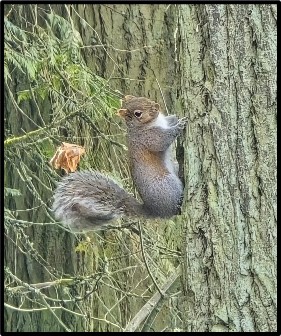
From the beginning, I knew it was going to be an excellent day. As I eased down the entry road, a Western Gray Squirrel scampered across the road and up into a tree. It circled the trunk, checking for who knows what, and then paused for a moment and looked back at me for a great photo opportunity. We never see the squirrels at the feeder by the contact station; they prefer the deep woods habitat on the road down. I’m not prone to getting up really early in the morning so I have to miss that part of the day on the refuge, but on this day, I was substituting for Roger, who was out of town and couldn’t do the bird list because of the road repair closures. It’s always makes me a little nervous because he’s so good at finding birds, after all, he’s been doing it for almost 20 years, so he knows where everything should be. It was in the low 20s, and before 8 am, a time of day I would prefer to be home with my slippers and hot coffee. But it was sunny and crisp and beautiful. I was lucky to hear Brown Creeper, Chestnut-backed Chickadee, and Hermit Thrush down the entry road. Good start.

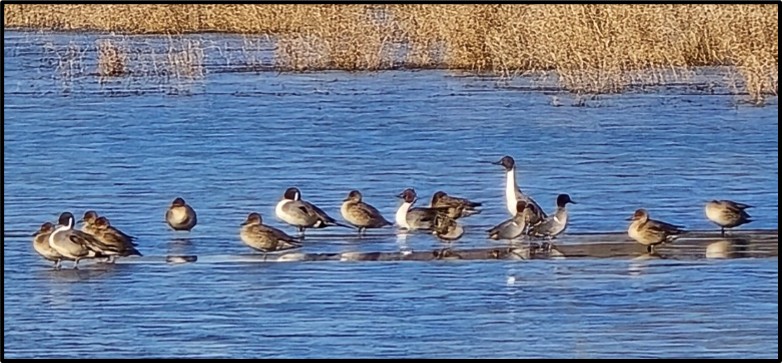
Driving onto the refuge, the first thing I noticed was the bright orange feet of the Northern Shovelers that stood upon the ice-covered ponds. Grasses were decorated with ice spikes glistening in the sun. Ducks were huddled together on little high points rising above the waterline, probably finding some warmth in the crush. Some were tucked into the shoreline waiting for a bit of a thaw before venturing into the water for food.
To dabble or to dive: Winter is a great time to watch ducks and their different strategies for getting food. The Northern Pintails and Green-winged Teal in the photo above are both dabblers, as are Northern Shovelers, Mallards, and American Wigeon. All are commonly seen on our ponds. They have similar physical characteristics. Their legs are centered on their body, enabling them to easily walk on land. They have large wings, which help them land in small ponds with precision and take off straight up from the water. The divers have smaller wings, and their legs are attached near the tail end of their bodies. Their large feet on stubby legs help them propel through water when searching for food. Although they are the faster fliers, with smaller wings, they need a water body with enough runway space to be able to get lift off, which they do as they “paddle” on the top of the water before they are airborne. The divers include Canvasbacks, Ring-necked Duck, Ruddy Duck, and scaup. Goldeneyes, mergansers, and Bufflehead, which we also see here occasionally, are ducks that dive but are not commonly lumped with the group called divers.
Dabblers feed by foraging in shallower water and can often be seen head in the water and butt up to the sky. They look for reachable aquatic plants, seeds, and insects and skim along the top of the water. I find Green-winged Teal fascinating, as from a distance, they forage bill pointed down in muddy edges where you will see Killdeer and other shorebirds eating, sometimes confusing me until I get my binoculars on them. Divers depress their body feathers to squeeze out air, arch their body and use their big feet to power underwater. Their legs are paddles, and they steer with their head and tail. Treading water, they probe the pond bottom for food. To return to the surface, they quit paddling and up they come.
An advantage of having such different capabilities for foraging is to help reduce competition for food supplies. Divers will usually be in deeper water, while dabblers will be closer to the edges. With our water levels changing so much in recent weeks, what you saw a month ago in one area may now have moved to a different set of ponds that are just right for them now. It is something to think about as you try to sort through our wintering waterfowl.
Our coots are not among either of these groups, but they do dive. Their legs are also positioned far toward their tail. One of the treats for me on my winter ride around was seeing coots out on an Icey edge as they walked out of the wetlands to find open water. Not exactly the loveliest birds, when they swim, they bob their heads forward as they move. Walking on lobbed feet, the head movement is even more comical as I watched them cross on the ice.
Gang Activity on the Refuge: No, don’t panic. Not that type of gang activity. At this time of year, it is not uncommon to see several subadult Bald Eagles moving around the refuge together, looking for or finding trouble. Well, that is how I see it. They can be very amusing to watch as they may try to steal food from each other or just be an annoyance. You might see them close together, sitting on the dike or in the field somewhere.
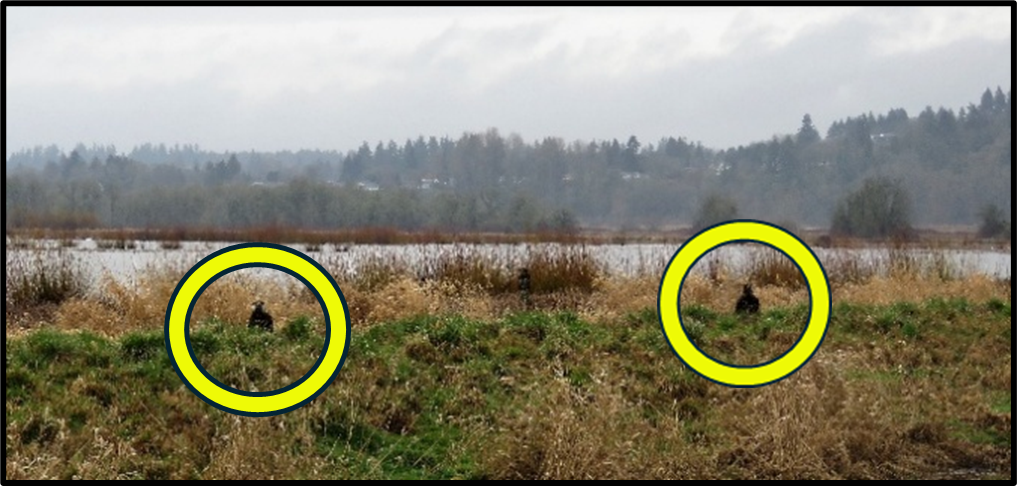
Bald Eagle migration is quite variable depending on location, their age, the climate of the breeding site, and winter food availability. In the Pacific Northwest, migratory movements coincide with salmon migrations. Going north, they go along the coast as far as the Chilkat River, Alaska, in late summer for the early runs. On their return to wintering grounds, they follow the salmon runs south down the coast, with adults arriving at Pacific Northwest wintering grounds during November and December and immatures arriving in January. That is what we have seen unfold this year. In some areas, a portion of the adults are resident. Sub-adults, 1 to 4+ years, are nomadic and can turn up anywhere, anytime as they are searching for food. There have been a few marking and banding studies to follow young birds to see where they end up nesting as adults. Not all adults nest every year, however. In several studies of marked birds, Bald Eagles will return to their natal areas to nest, but in variable percentages and distances. So, do you think some of the eagles nesting here were also born here? Certainly possible. But is it possible we can see more nesting pairs in the future, or with the growth of our suburban communities, will food and nest site availability be insufficient to grow or even sustain the population? Certainly, all the work in the state to help salmon spawning will be helpful. Keeping our refuge healthy is also very important.
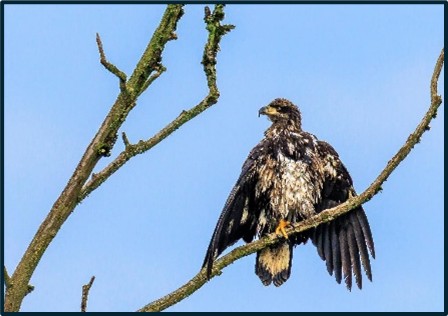
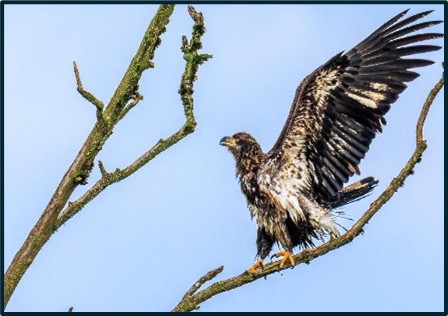
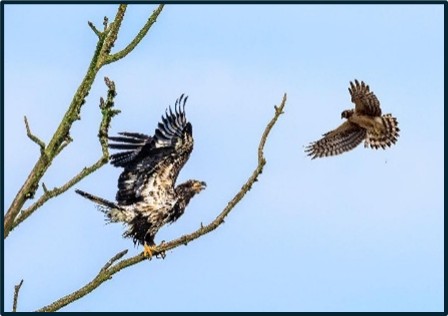
Sometimes a young Bald Eagle gets a little harassment, too. In this sequence taken by Charlie Rutkowski, the young eagle is trying to dry out after our latest downpour in January in frame one. It spots another raptor and gets big. The annoyed Northern Harrier shows it is not happy with the young eagle in its space. The eagle was left to dry his feathers after all.
Enjoy our winter. Look for more icy mornings and lots of Bald Eagle activity. See if you can sort out the divers from the dabblers.
-Susan Setterberg, Ridgefield NWR Contact Station Volunteer
Stay updated on Refuge events, news, and wildlife sightings!


Shop for items that the Friends and the Refuge Complex need to help with everything from habitat restoration to events like BirdFest & Bluegrass, and help support wildlife in little and big ways.
Learn More »
Sign up for the Community Rewards program by linking your Fred Meyer Rewards Card to Friends of Ridgefield National Wildlife Refuge (PK822). For more information, please visit the link below.
Learn More »