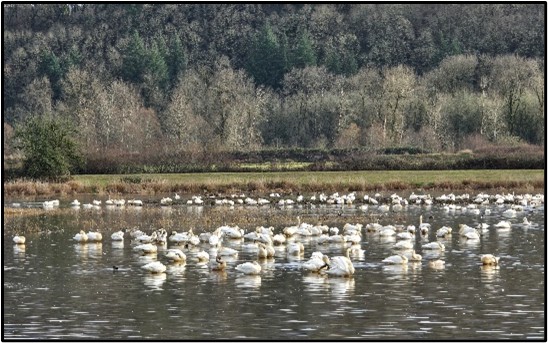
One Friday morning in mid-December, as I was driving over the bridge to the contact station, I was astounded to see an abundance of big white birds in Long Lake, the sliver of water west of the Contact Station along the tree line. I stopped for a moment to enjoy the beautiful view. Later that afternoon, having heard comments from so many visitors about the huge numbers of swans, I drove the River S to see for myself. They were everywhere and easily viewable close to the road. Usually, we are straining to see them at the back of the larger lakes, which makes them hard to distinguish as Trumpeter or Tundra Swans unless you hear them. Easily, a total for the River S and what you can see on the close lakes of the Hunt Zone, could be put close to 2500 swans. Wow, and why such huge numbers here?
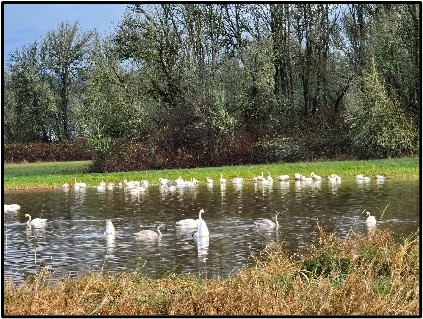
The weather is always a factor. The rains were so heavy in December that our ponds and lakes filled rapidly to levels we rarely see. Swans generally use the deepest areas of our lakes. Unlike other waterfowl, with their long necks, they can easily reach vegetation in deeper water. Often, our swans, besides using Carty Lake, like to use Campbell Lake in the closed Roth Unit south of the River S. Both have more depth than most. However, this year, Campbell was so full it became too deep for even the swans, so they have concentrated in the River S and hunt areas to find the water level that is just right.
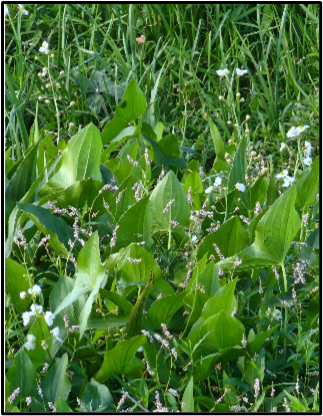
Food is always a factor, too. You may have noticed that many of our ponds were dense with vegetation going into the fall. Long Lake, in particular, had a very good growth of Wapato, or Broadleaf Arrowroot, also known as duck potatoes. This is a favorite source of food for swans, who dig into the muddy bottom of the wetlands to eat the starch-rich tubers. Have you noticed that ducks will sometimes swim in the vicinity of an eating swan? The swans are good at breaking up the tubers to eat them, and they are not exactly the neatest eaters. So, some ducks hang around to grab a “crumb” or two from the remnants of a swan meal. Watch for it.
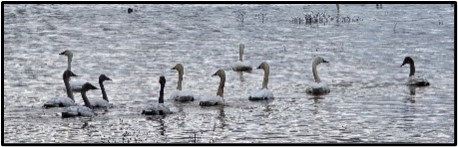
One more thought as we watch the swans in abundance. The refuge team is constantly working to provide the best habitat for our wildlife. They have worked hard over the last several years to break up vegetation in the ponds late in summer. That allows the native seedbed to have a chance to compete and outgrow the invasives. Although there are times in the season when, as wildlife observers, we might be frustrated by the density of vegetation blocking our views into the wetlands, that vegetation provides an abundance of food for our wintering waterfowl and others.
We are getting a good opportunity to hear both the Trumpeters and the Tundras. Use your Merlin app to help distinguish between the two. I wrote extensively about the swans in 2023 when we also had a very good year. To learn more about them, you can go back to that article here, https://ridgefieldfriends.org/contact-station-april-2023/. The Trumpeter populations have continued to grow. However, there are new challenges for them, as with many other species, because of Avian Flu. Also, lead poisoning due to the use of lead shot by hunters remains a challenge for large birds like the swans. Since much hunting is done in wetlands where they feed, they can be exposed to spent shot. Fortunately, lead shot is not allowed on national wildlife refuges, so is not a problem in our wetlands.
Seen any weird cranes lately? Well, occasionally appearing to the west over the tree line in the north end of the River S is a giant crane of the metal type. The crane is moving around some seriously large piping that is being installed as part of the new water pumping system. It will be replacing our ancient, decrepit pumps with a high-speed version, which should help the staff balance the water needs. Last time I talked to the biologist, he was considering pumping water out of our lakes in some places because it was too high for the dabbling ducks (mallards, Green-winged Teal, and Gadwall, for example). They can’t reach all the vegetation down in many of the lakes now. If you have been driving the auto tour lately, you might have noticed a distinct absence of Gadwall in particular.
On January 4, 2026, we will have a number of local birders participating in the 126th Christmas Bird Count around the entire Refuge. You may see them going into the closed sections of the refuge to identify and count every bird they can find. The count runs for one day, twenty-four hours. Although the counters won’t be camping out, they will be able to come onto the refuge a little early or stay late to listen for owls. Only pre-registered team members will be allowed to participate. We will have some results to share in a month or two. It will be especially interesting to see what the swan count is this year.
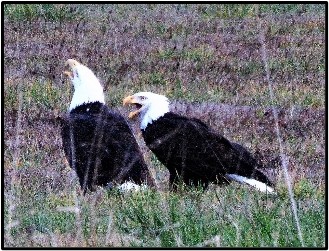
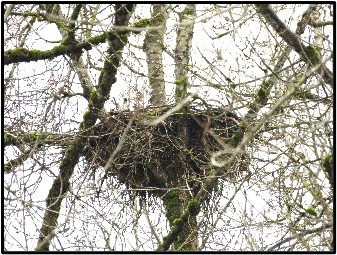
What is on the horizon? Keep an eye on the Bald Eagles. The pairs are hanging out together and chatting a lot. It is time to think about sprucing up the old nest again!
-Susan Setterberg, Ridgefield National Wildlife Refuge Contact Station Volunteer
images by Susan Setterberg
Stay updated on Refuge events, news, and wildlife sightings!

Shop for items that the Friends and the Refuge Complex need to help with everything from habitat restoration to events like BirdFest & Bluegrass, and help support wildlife in little and big ways.
Learn More »
Sign up for the Community Rewards program by linking your Fred Meyer Rewards Card to Friends of Ridgefield National Wildlife Refuge (PK822). For more information, please visit the link below.
Learn More »